
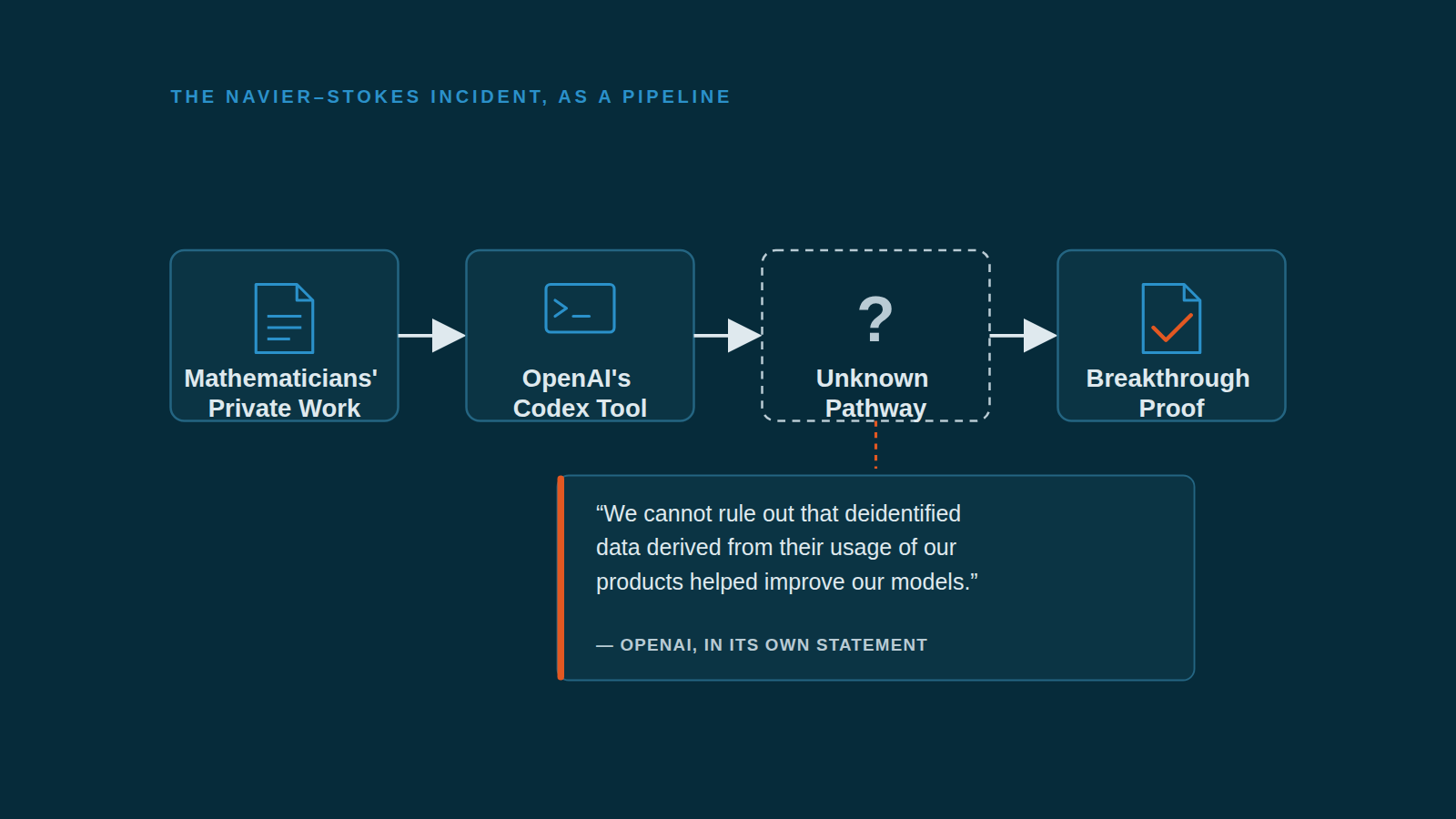
OpenAI just solved the Navier Stokes problem, a fluid dynamics math question that's been open for 90 years with a million dollar prize attached. That's the headline. The part I actually care about is what happened around it.
What Happened With OpenAI and the Navier-Stokes Proof
Two mathematicians, Tristan Buckmaster and Levent Alpagy, spent a year working on this same problem using OpenAI's codex tool. They stored their drafts there. A few weeks after they hit a real breakthrough, OpenAI's own model produced a proof using the exact same unusual approach the two mathematicians had been using. OpenAI says they never accessed the private work directly. But their own statement includes this line: "we cannot rule out that deidentified data derived from their usage of our products helped improve our models."
I think you should read that again. Even the company built on defending its own model training practices won't say for certain that your data didn't end up shaping their next model.
The Real Lesson: You're Handing Over Your Expertise
I think this is the real lesson here, not the math. If you're building a business on top of someone else's AI model, you're handing over your expertise every time you use it. Your prompts, your data, your specific way of solving a problem, all of it potentially becomes training signal for a competitor's future model, including one built by the same company you're paying for API access.
This is why I keep coming back to local AI for anything that touches real client work or proprietary logic. Running a model on your own machine, or at least on infrastructure you control, means your data stays yours. Nobody can quietly fold your six months of prompt history into their next release. Nobody can call you a year later to negotiate who gets credit for what your work produced.
I'm not saying frontier cloud models don't have their place. For a lot of tasks, they're genuinely better than what you can run locally, and the gap isn't closing anytime soon for the hardest problems. But for anything sensitive, anything that's actually your competitive edge, I don't think that tradeoff makes sense anymore. The Navier Stokes story is a pretty direct example of what platform risk actually looks like in practice, not a hypothetical.
Local AI Has Gotten More Usable
The good news is local AI has gotten a lot more usable in the last year. Models you can run on a decent laptop or a modest home server can handle a surprising amount of real work now, especially anything involving your own documents, your own codebase, or your own processes. You lose some raw capability compared to the biggest cloud models, but you gain something that's becoming more valuable by the month: nobody else gets to look at what you're doing.
What This Looks Like for Me, Day to Day
Here's what that actually looks like for me day to day. I write a lot of code with Gemma running locally, Google's model, and I use it for semantic embeddings too, when I need to search across a codebase or a folder of documents instead of grepping for keywords. None of that leaves my machine.
For heavier work I run bigger models through Ollama, qwen3.5:27b-mlx on a MacBook Pro with 64GB of RAM. It's not as fast as a frontier API call, but it's fast enough, and it never phones home.
On a document search project I built called Ferret Out, I used SentenceTransformers locally to generate the vector embeddings before I ever looked at a hosted embedding service like Bedrock Titan. The documents in that case were service manuals and spec sheets a client handed me. Not something I wanted feeding anyone's training pipeline.
I'm also working through building a local AI agent from scratch in TypeScript instead of wiring everything through a hosted agent framework. It's slower going. But I know exactly what that agent is doing with my data, because I wrote the part that does it.
If you're building something that depends on AI, it's worth asking where your data actually goes and who else might eventually benefit from it. That question is only going to matter more as these companies keep racing each other to the next model.
← Back to Articles