
I've been thinking about this the way I think about staffing a project. You don't put your most expensive, most flexible person on a task that just needs a checklist followed. You match the tool to the job. That's the whole story with single LLM features, structured workflows, and autonomous agents.
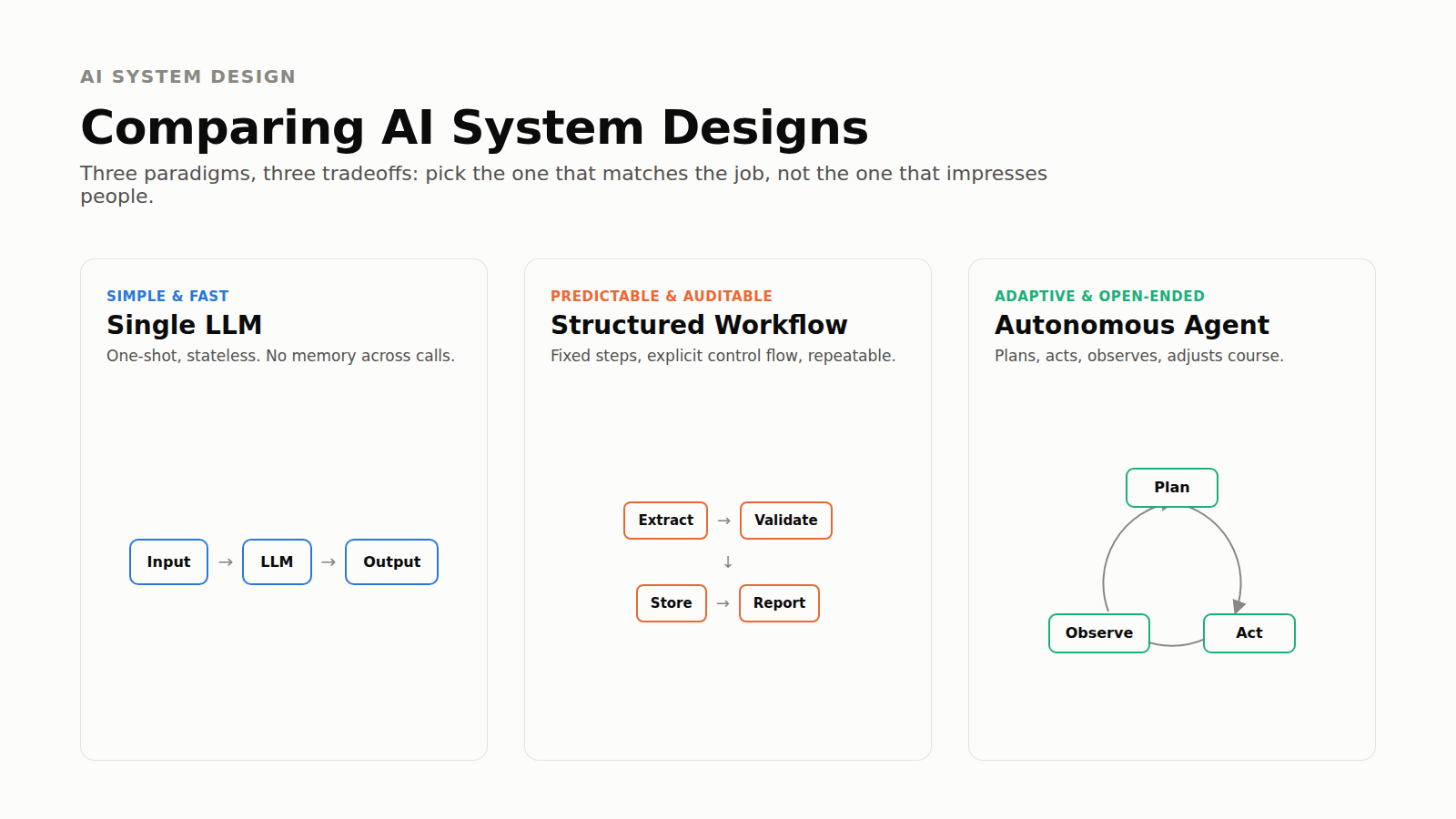
A single LLM call is the checklist-follower. You feed it text, it gives you an output, done. No memory, no context carried forward, nothing dynamic happening. Summarizing an article, classifying sentiment, translating a paragraph. It's fast and it's cheap because there's no orchestration overhead sitting on top of it. The tradeoff is obvious: it can't adapt. Ask it to do anything with multiple steps or shifting context and it falls apart, because it was never built to hold onto anything.
Structured workflows are a step up, and this is the one I recognize most from program management. You're chaining LLM calls and tool calls together in a fixed, predictable order. Think insurance claims processing: scan the document, extract the fields, validate them, store the result. Every step has to happen in that sequence every time, or you don't have a process, you have chaos. That's why this pattern shows up in compliance-heavy work, financial transactions, healthcare processing, anywhere an auditor might eventually ask "walk me through exactly what happened here." The workflow gives you that answer for free. What it costs you is flexibility. If a claim comes in that doesn't fit the pattern, you're writing new code to handle the exception, not adapting on the fly.
Autonomous agents are the ones I'd actually be nervous handing a blank check to. They plan, they act, they observe the result, and they loop back and adjust, choosing their own tools along the way. The vacation-planning assistant is a good example: it has to gather preferences, research options, make suggestions, take feedback, and change course, none of which follows a fixed script. That's real adaptability, and for genuinely open-ended problems it's the only paradigm that works. But I don't think you deploy this by default. More moving parts means more ways for it to go sideways, and debugging "why did the agent decide to do that" is a much harder conversation than debugging a workflow step that failed on a null value.
So my read on this is pretty simple: start with the cheapest tool that solves the problem, not the most impressive one. If a single LLM call gets the job done, that's the right answer, not a stepping stone to something fancier. Reach for a workflow when the steps are known and repeatable and someone might need to audit them later. Save agents for the problems that actually are open-ended, where you genuinely don't know the path ahead of time.
The trend I'd bet on is hybrid setups, workflows doing the predictable heavy lifting with an agent handling the one step that needs judgment. Standards like MCP and ACP are making that combination easier to wire together, which means the "pick one paradigm" framing probably won't hold for long. Good problems to have.
← Back to Articles