
Most of us learned Maslow's hierarchy of needs in school. Food and shelter at the bottom, self-actualization at the top. It's easy to remember, but people don't work that way. I've known people who were broke and still chasing something meaningful. Motivation doesn't climb a pyramid one level at a time.
A Better Lens Than Maslow: Self-Determination Theory
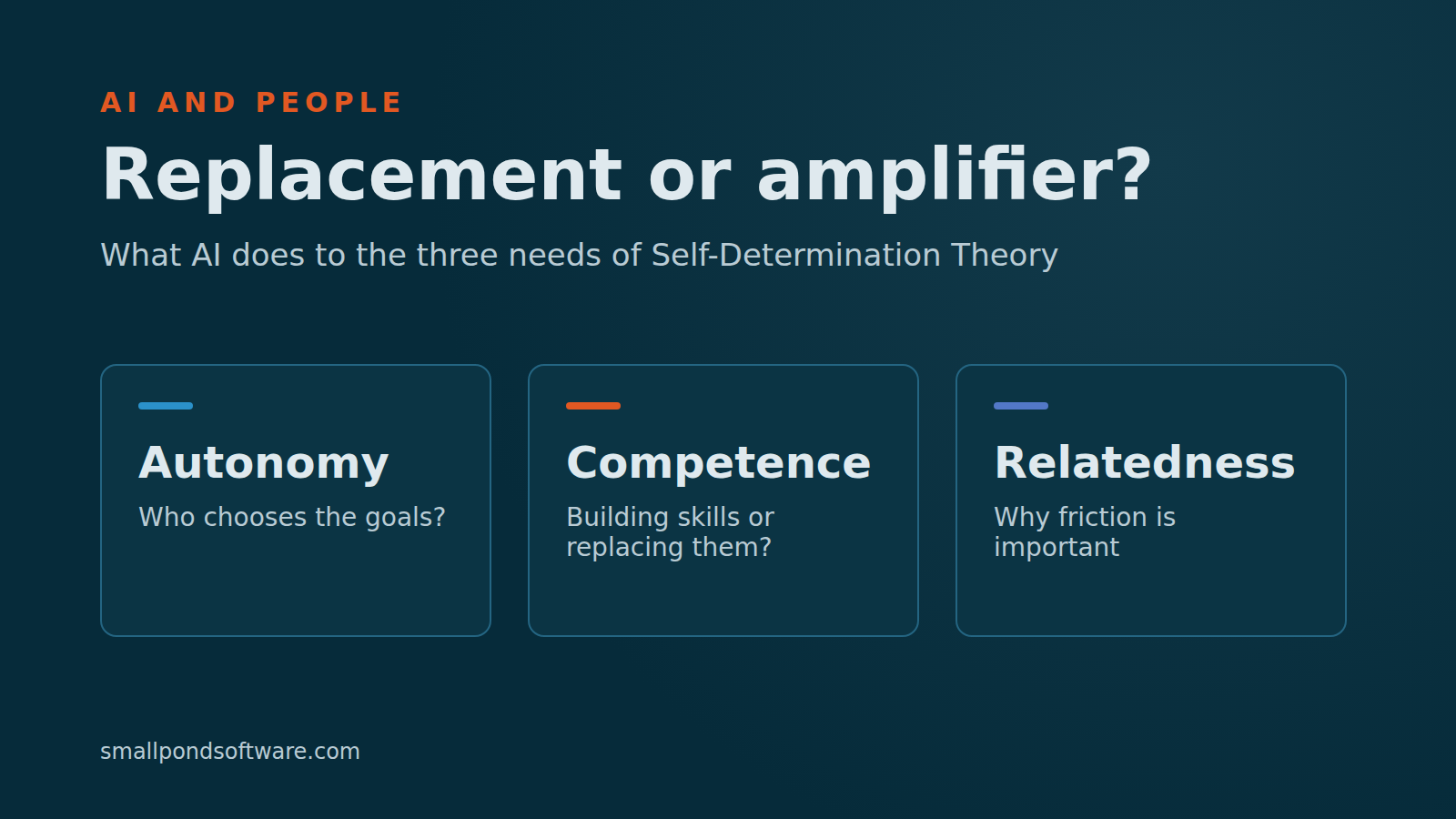
When I think about what AI is doing to people, I find Self-Determination Theory more useful. It narrows human needs down to three: autonomy, competence, and relatedness. AI can strengthen each one or weaken it, and I don't think most people are paying attention to which way it's going.
Competence: Does AI Build Skills or Replace Them?
I use AI every day in my agency. In a few minutes I can get working code for a Lambda function that used to take me an afternoon. But producing something and being able to produce it are different things. I learned JavaScript by writing bad code, watching it break and fixing it. If AI removes that loop, my output goes up while my ability quietly goes down.
Autonomy: Who Is Choosing the Goals?
Someone who can't code can now build an app. But what happens when we stop asking AI how to reach our goals and start asking it what our goals should be? What should I learn? What career should I pursue? What should I believe? A tool that makes it easier to act can also make it easier to stop choosing.
Relatedness: Why Friction in Relationships Matters
AI can help you say something hard or find a community you didn't know existed. It can also be easier than people. People disagree with you. They let you down. They need things from you at bad times. I think that friction is a big part of why relationships matter.
Take a friendship. Say a friend calls at 10 PM because their marriage is falling apart, and you have to be up at 6. Nothing about that is convenient. But showing up anyway is what makes them a friend, and it's what makes you one. An AI companion will listen any time, never needs a favor and never has a bad week of its own. That sounds nice until you realize you never get to be there for it either.
Conflict works the same way. If you ask AI to write the text to your spouse after an argument, it'll probably do a better job than you would. But figuring out what you actually want to say, and then hearing their side, is how the two of you fix it. Hand that off and the message gets sent, but the relationship doesn't get repaired.
I've seen this play out in my own family. My daughter's boyfriend was trying to repair their relationship, so he started using AI to write his text messages and sending them to her over Snapchat. It didn't work. They broke up anyway. I don't think the problem was the wording. I think she needed to hear from him, in his own words, even if they came out clumsy.
That's the trade I'd watch for. Use AI to help you get to people, not to get around them.
What the Industrial Revolution Teaches Us About AI
We've been through something like this before.
In the late 1700s the Industrial Revolution pulled millions of people off farms and into factories. Families who had worked the land for generations were suddenly putting in 12 to 14 hour days in textile mills, kids included. Skilled weavers watched machines make their craft worthless. From 1811 to 1816 the Luddites smashed looms in protest.
The disruption didn't stay local. Marx and Engels published The Communist Manifesto in 1848, shaped by what they saw in industrial cities like Manchester, and those ideas eventually fueled revolutions that reshaped half the world. Industrial production also made war far more deadly, which the world learned in 1914.
That was a brutal transition, and I don't want to gloss over it.
But look at where it ended up. Britain passed the Factory Act in 1833 to limit child labor. Over time we got the 8-hour day, the weekend and public schools. Life expectancy in Britain roughly doubled. In a lot of ways, the average person today lives better than a king did in 1750.
What I take from that is that the technology wasn't the good part. The good part was people deciding how to use it and what to protect along the way.
Use AI as an Amplifier, Not a Replacement
I think that's where we are with AI. The useful question is whether we use it as a replacement or as an amplifier. Is it deciding for you, or helping you decide better? Is it doing the skill for you, or helping you learn it? It's the same thinking I use when helping a business figure out what to automate first: hand the machine the repetitive work, and keep the judgment with people.
This doesn't have to be people versus machines. It can be people using machines to become more capable and more ambitious. Doing the work is how you become the person who can do it.
← Back to Articles