
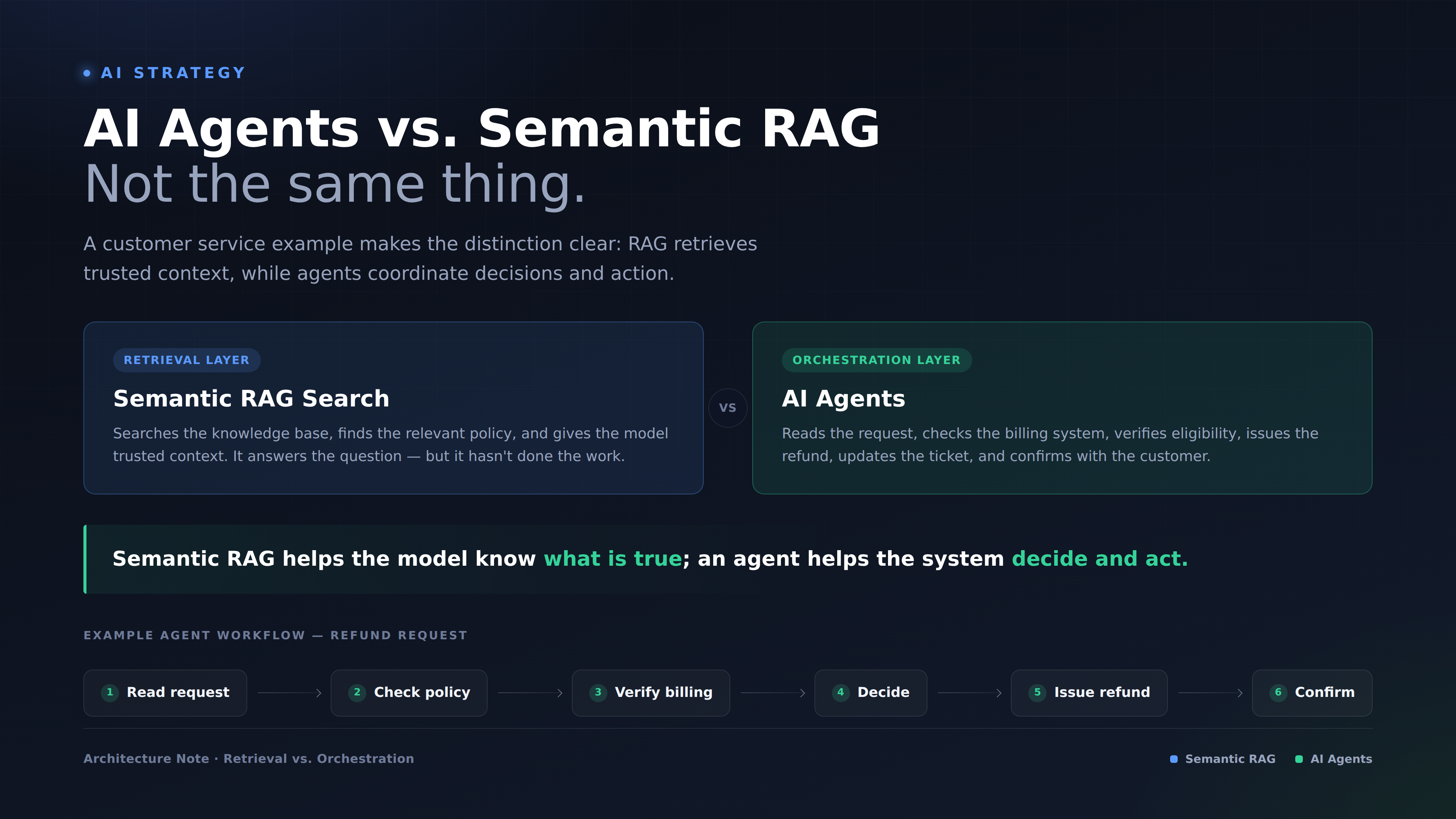
A customer emails asking for a refund on an annual subscription, canceled two days after it renewed. That one question is enough to show why AI agents and semantic RAG search keep getting talked about like they're interchangeable. They're not, and mixing them up is the kind of thing that gets a team in trouble, because it leads them to promise a system can do more than it actually can.
Here's what a semantic RAG system does with that refund question. It searches the knowledge base, finds the refund policy, and hands the relevant passage to the model as context. The model comes back with something like "annual renewals are eligible for a refund if canceled within seven days." That's a real answer, and a useful one. But nothing has actually happened yet. Nobody got refunded.
An agent is built to finish the job, not just answer the question. Given that same refund request, an agent would read the message, pull the policy, check the billing system, confirm the renewal date, verify the cancellation happened inside the window, issue the refund through the payments API, update the support ticket, and send a confirmation email. That's eight steps, and every one of them is a place something can go wrong if the system isn't built carefully.
In a more mature setup, that single agent becomes several agents working together, each one responsible for a narrower piece:
- A policy agent that retrieves and interprets the refund rules.
- A billing agent that checks invoices, renewal dates, payment status, and any prior refunds.
- A risk or compliance agent that watches for disputes, chargebacks, fraud signals, or refund amounts that look unusually high.
- A communications agent that drafts the actual reply to the customer, in the right tone.
- A supervisor agent that decides whether the case is simple enough to close automatically, or whether it needs a human to sign off.
I think that last role, the supervisor, is the one people underestimate. It's the difference between a system that's fast and a system you can trust.
The risk profile is where this really matters. If a RAG system gets the refund policy wrong, the customer is confused and asks again, or a person steps in. Annoying, not dangerous. If an agent gets it wrong, it might issue a refund that shouldn't have gone out, touch the wrong account, or send a message that commits the company to something it shouldn't have. That's not a confused customer anymore. That's an operational problem, and depending on the mistake, a financial one.
So the clean way to think about it: semantic RAG is a retrieval layer. It's about chunking, embeddings, ranking, freshness, permissions, and citations, getting the right information in front of the model. An AI agent is an orchestration layer on top of that. It has to deal with tool access, planning, state, retries, approvals, audit logs, rollback, and what to do when a step fails partway through. RAG can find the policy. An agent has to use it, check the account, make a call, and see it through.
None of that means agents are too risky to build. It means the build has to match the stakes. A refund agent that can approve small, clean cases on its own and kicks anything unusual to a person isn't slower, it's just designed with the failure modes in mind from the start. That's the part worth getting right before scaling anything up. Get the guardrails in early, and the speed takes care of itself.
← Back to Articles